

毎月、GOWUKAKUは1500人以上の受験者が試験準備を助けて、試験に合格するために受験者にご協力します
Designing Cisco Enterprise Wireless Networks (ENWLSD) 試験
最新更新時間: 2026/09/27
【秋学習応援セール|10月限定キャンペーン】:300-425 最新真題を買う時、日本語版と英語版両方を同時に獲得できます。
実際の問題集を練習し、試験のポイントを了解し、テストに申し込むするかどうかを決めることができます。
さらに試験準備時間の35%を節約するには、300-425 問題集を使用してください。
Question No : 1
An enterprise network administrator is asked to set up an experimental WLAN for a collaboration project with a local service provider. The WLAN must be anchored to a WLC in the service provider data center using legacy mobility mode. After the configurations are completed on the WLCs and the firewalls in the path, the data path mobility tunnel is failing to come up.
What should be performed by the administrator to debug the issue?
正解:
Explanation:
When a data path mobility tunnel fails to come up, one of the troubleshooting steps is to check if the necessary ports are open and not being blocked by any firewalls in the path. Since the mobility tunnel uses CAPWAP, which operates on UDP ports 16666 (control path) and 16667 (data path), establishing a Telnet connection to the firewall on port 16666 can help determine if the control path is open and if there are any issues that need to be addressed3.
Reference: https://www.cisco.com/c/en/us/support/docs/wireless/4400-series-wireless-lan-controllers/107458-wga-faq.html
Community vote distribution
Question No : 2
A wireless engineer is designing a wireless network to support real time applications over wireless.
Which IEEE protocol must the engineer enable on the WLC so that neighbor list radio management packets are sent to the wireless devices?
正解:
Explanation:
The IEEE 802.11k protocol is designed to enable radio resource measurement and neighbor list radio management packets. This protocol allows wireless devices to better understand their radio environment, which in turn supports real-time applications over wireless by enabling devices to make quicker and more informed decisions about roaming
Question No : 3
An engineer is designing a high-density WLAN for a 10,000-seat auditorium. The solution must take advantage of human attenuation, as well as the aesthetics of the room.
Where must the APs be placed?
正解:
Explanation:
For a high-density WLAN environment like a 10,000-seat auditorium, placing APs under the seats can
take advantage of human attenuation and maintain the aesthetics of the room. Human bodies absorb Wi-Fi signals, and placing APs under the seats helps in mitigating this effect by having the signals emanate from among the audience, rather than from above where the signals would have to pass through the audience, resulting in signal degradation1.
Question No : 4
An engineer is designing a new wireless network.
The network needs to fulfill the following requirements:
✑ support multimedia applications
✑ support a high concentration of wireless clients
✑ support data over wireless
✑ support roaming
Which approach should be used?
正解:
Explanation:
Micro cells with reduced power levels are suitable for environments with a high concentration of wireless clients and multimedia applications, as they help manage interference and allow for better roaming capabilities.
Reference: ENWLSD 300-425 Official Cert Guide.
Question No : 5
An engineer is designing a wireless network to support Cisco Hyperlocation. The customer indicated some How is the design adjusted?
正解:
Explanation:
Cisco Hyperlocation requires a dense deployment of access points for accurate location tracking. Adding more APs than a standard site survey suggests can meet the granular location requirements needed for Hyperlocation services.
Reference: ENWLSD official certification guide.
Question No : 6
A wireless engineer is getting ready to perform a predictive site survey. The new network needs to support data and voice over wireless.
Which two Cisco recommendations should be considered for the design? (Choose two.)
正解:
Explanation:
The 5 GHz band is recommended for voice over wireless due to its wider channel bandwidths, allowing for higher data rates. Setting the cell boundary at -67 dBm ensures sufficient signal strength for reliable voice communication.
Reference: CCNP Enterprise Wireless Design ENWLSD 300-425 Official Cert Guide.
Question No : 7
Refer to the exhibit.
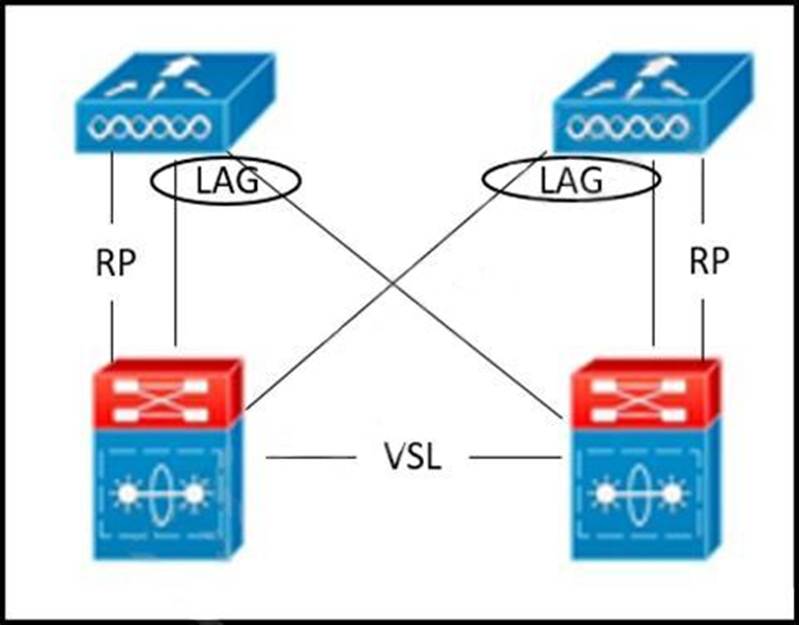
A WLC SSO pair is set up.
Which failure scenario causes a split-brain scenario?
正解:
Explanation:
The Virtual Switching Link (VSL) is essential for communication between the active and standby Wireless LAN Controllers (WLCs) in a Stateful Switch Over (SSO) setup. If the VSL goes down, it can lead to a split-brain scenario where both WLCs assume they are active, causing network disruptions and inconsistencies in client handling.
Reference: Designing Cisco Enterprise Wireless Networks (ENWLSD 300-425) Official Cert Guide.
Question No : 8
WLC SSO is set up between two WLCs in a service provider network serving public spaces. On WLC failover, it is noticed that only about half of the original client count is now showing on the secondary WLC, although it is currently showing the role as active.
Which design side case explains the issue?
正解:
Explanation:
When a Wireless LAN Controller (WLC) SSO is set up between two WLCs in a service provider network, and there is a failover, the secondary WLC should ideally support the same client count as the primary. If only about half of the original client count is showing on the secondary WLC post-failover, it suggests that the WLCs had not completed the database synchronization before the primary WLC failed. This incomplete sync would result in a loss of client information, leading to a reduced client count on the secondary WLC.
Question No : 9
A customer has multiple WLCs running N+1 redundancy with APs equally distributed. Only one WLC is a designated backup for all other WLCs so the customer must ensure that the most critical APs remain registered or get priority over other APs in case of a WLC failure. However, the customer notices on WLC failure that some critical APs remain unregistered.
What needs to be addressed in the design?
正解:
Explanation:
In a scenario where a customer has multiple Wireless LAN Controllers (WLCs) running N+1 redundancy with Access Points (APs) equally distributed, the critical APs must have priority in case of a WLC failure. If critical APs remain unregistered during a WLC failure, it indicates that the AP failover priority is not enabled globally on the backup WLC. Enabling AP failover priority ensures that critical APs are given precedence over other APs, allowing them to register with the backup WLC first.
Question No : 10
A network engineer is troubleshooting connectivity issues between two WLCs running 8.x code in SSO mode and finds that the redundancy management heartbeat is failing.
Which packet type must be filtered for heartbeats when taking a capture to verify communication?
正解:
Explanation:
The redundancy management heartbeat in Cisco Wireless LAN Controllers (WLCs) running 8.x code in Stateful Switch Over (SSO) mode uses UDP packets for communication. When troubleshooting connectivity issues between two WLCs, it is essential to filter for UDP packets in a packet capture to verify the heartbeat communication. The heartbeat packets are sent on a specific UDP port, and filtering for this port can help isolate the heartbeat traffic from other types of traffic in the capture.
Question No : 11
During a wireless design all APs are mapped to designated controllers in case of a failure. The controllers are located in the same data center but in different racks. An AP failed over to a controller that was not defined on its High Availability tab. The customer does not want the AP to move back to its defined Cisco WLCs until they manually intervene.
What needs to be addressed in the design?
正解:
Explanation:
Setting AP fallback to disabled will prevent the AP from moving back to its defined Cisco WLCs automatically after failing over to an undefined controller. This allows manual intervention to determine when the AP should revert to its primary controller.
Question No : 12
An enterprise is using a Cisco AireOS controller and Wi-Fi 6 APs. The controller is installed in the head office, and the employees primarily use Apple OS devices. The APs broadcast WLAN ENT-WLAN406558520-1 for the employees and a guest WLAN with similar naming.
What needs to be enabled on the controller to optimize roaming?
正解:
Explanation:
Aggregated Probe Response Optimization should be enabled on the controller to optimize roaming, especially for environments with a high density of Apple OS devices. This feature reduces airtime consumption and overhead by aggregating probe responses, which can improve the roaming experience for the employees.
Question No : 13
APs in a remote office recently have been converted from local mode to FlexConnect to take advantage of the local switching. After the change, remote wireless users report voice quality issues and bad quality on wireless IP phones while roaming. A debug is performed, and it is noticed that the 802.11r Fast Transition is not working as expected, like on local mode AP, though the same WLAN configuration is in place.
What is the cause of the issue regarding the FlexConnect APs?
正解:
Explanation:
FlexConnect APs must be in a FlexConnect group to support 802.11r Fast Transition (FT). This grouping allows for local authentication and key management, which are necessary for fast roaming methods that improve voice quality and wireless IP phone performance during roaming.
Reference: The official Cisco FlexConnect configuration guide
Reference: https://www.cisco.com/c/dam/en/us/td/docs/wireless/controller/technotes/80211r-ft/b-80211r-dg.html
Question No : 14
An engineer is configuring a centralized set of controllers for separate facilities.
Which two Cisco wireless architectures must be used to ensure flexible sizing of WLAN to VLAN mappings? (Choose two.)
正解:
Explanation:
Interface groups allow for flexible WLAN to VLAN mappings by grouping multiple interfaces into a single entity. This enables a single WLAN to be mapped to multiple VLANs, providing scalability and flexibility in network design. AP groups are used to manage the configuration of multiple APs collectively, allowing for consistent WLAN to VLAN mappings across different APs in separate facilities.
Question No : 15
An engineer has designed an anchor redundancy for guest clients connecting to SSID with auto-anchor configured. After adding a second Anchor WLC under the SSID mobility anchor list, clients are load-balanced between existing and new anchors instead of having one anchor as active and the other one as standby.
Which feature should be included in the design that will be configured on the WLC running 8.1 or above to ensure anchor redundancy?
正解:
Explanation:
When designing anchor redundancy for guest clients with auto-anchor configured on a WLC running version 8.1 or above, setting up Guest Anchor Priority ensures that one anchor is treated as active while another acts as standby rather than load-balancing clients between anchors which is not desired in this case.
Reference: = (CCNP Enterprise Wireless Design ENWLSD 300-425 and Implementation ENWLSI 300-430 Official Cert Guide Premium Edition and Practice)